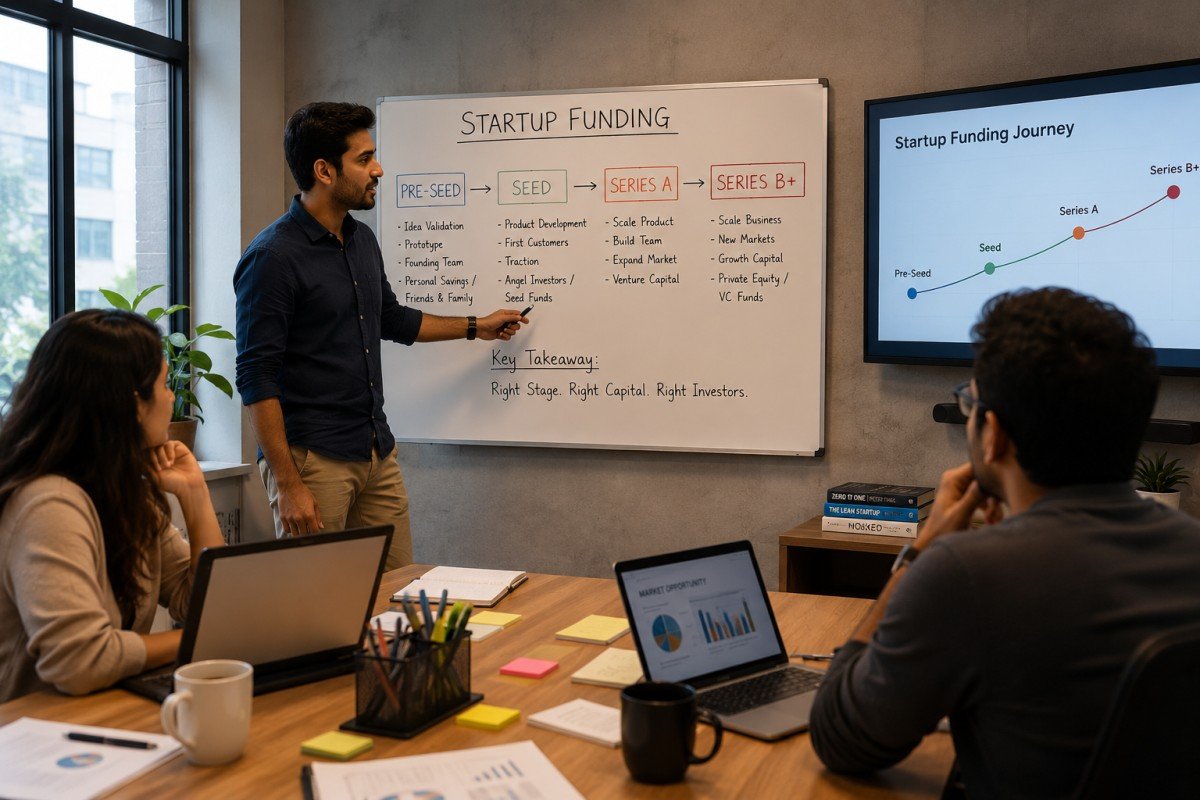
Starting a business is exciting, but turning an idea into a successful company requires vision, dedication, and money. While passion fuels innovation, adequate funding helps transform ideas into reality.
From developing your first product to expanding into new markets, every stage of growth requires the right financial support. Understanding startup funding stages can make the journey far less overwhelming.
Each funding stage serves a different purpose, with investors evaluating different goals and analyzing performance metrics at every step. Without the right financial support, even the most promising startup may struggle to compete in the market. This blog focuses on the top startup funding guide to follow for sustainable business growth.
How Startup Funding Works ?
Startup funding is the backbone of every successful business. Now the question is, how does startup funding work? Start by building a strong product before seeking external funding from investors. Try to use funding strategically to hire talented employees, improve your technology, strengthen marketing efforts, expand into new markets, and scale operations sustainably. A well-defined startup operation strategy ensures that businesses can effectively allocate resources after securing funding.
How Funding Fuels Startup Growth ?
Funding provides long-term business growth when used strategically, allowing startups to scale their business functions effectively. Startup funding stages have different outcomes. Early stages carry high risk accompanied by massive returns. Whereas late-stage funding offers stability. Keep a close eye on cash flow, avoid giving away too much equity early, and choose investors who can offer valuable industry expertise in addition to funding. Remember, the right funding depends on your financial planning, business goals, growth plans, and industry.
The Startup Funding Journey at a Glance

Bootstrapping:
Bootstrapping involves starting the business relying on personal finances. This means using your own savings instead of taking outside investment.
Advantages
- This self-funding strategy helps in cost control. This is one of the main milestones of a startup funding roadmap.
- Bootstrapping allows founders to retain complete ownership of their business without giving away equity to investors. This navigates initial financial challenges and builds a foundation for success.
- Founders have the flexibility to make strategic decisions without seeking approval from investors. This can lead to substantial growth if managed effectively.
Disadvantages
- Bootstrapping is generally seen as a temporary solution for business needs until more permanent funding sources become available. This is the initial stage of the startup funding process.
- Without external funding, startups often have fewer financial resources for hiring, marketing, and product development.
- Bootstrapping can limit scalability due to delayed growth. Founders often invest their own savings. If the startup fails, it may lead to significant financial losses.
Example
Mailchimp started bootstrapping, relying solely on customer revenue. Later on, it led to long-term success. Proving that sustainable growth without external funding is possible.
Friends and Family Funding:
This is the initial round of funding for many startups. Once founders have an overall idea, they seek small investments from people they trust.
Advantages
- Raising money from family and friends is often quicker than approaching banks or investors. This is one of the most convenient ways for startups to raise capital.
- It typically involves smaller investments. This round can be crucial for validating your business idea and developing investors’ confidence.
- Support from loved ones can give founders confidence to pursue their business idea.
Disadvantages
- If businesses do not succeed, then it may create tension among family members. Beyond clearly communicating the risks, it’s crucial to consider how to present your idea effectively and structure the investment.
- Lack of professional advice can disrupt the strategic flow of development.
- There might be emotional turbulence among friends and family knowing that they are using money from their close acquaintances. The agenda is to inspire confidence without overwhelming them with unnecessary complexity.
Example
Many successful entrepreneurs, including the founders of Amazon, received early financial support from family members before attracting institutional investors.
Pre-Seed Funding:

Pre-seed money is the earliest part of the startup funding options. Few startups manage to secure capital at this stage. Pre-seed capital begins as a loan, and when certain growth conditions are met, the loan turns into a certain amount of equity.
Advantages
- Pre-seed funding helps to build a prototype that allows them to test and verify their business idea before launching.
- This strategy is important because the money will go toward constructing the company’s foundation. This reduces the financial burden on the founders.
- Securing pre-seed funding shows that investors believe in the startup’s potential. This credibility can make it easier to raise future funding.
Disadvantages
- Pre-seed investment difficult to secure. The process will be long and complex, but securing the support of pre-seed investors has the potential to supercharge a business’s growth.
- Investors often fund only startups with strong teams and promising ideas. Pre-seed is often best suited for industries with high startup costs. Without traction, raising pre-seed capital can be challenging.
- Since the startup is in its primary stages, validation is usually low compared to the later stages.
Example
Many startups like Y Combinator receive pre-seed funding to validate their products before pursuing larger investment rounds.
Many early-stage startups raise capital through SAFE (Simple Agreement for Future Equity) or Convertible Notes instead of issuing shares immediately.
| Factor | Safe | Convertible Note |
| Maturity Date | No maturity date | Has a maturity date |
| Repayment | No repayment required | May require repayment if not converted. |
| Best for | Very early stage startups | Startups expecting a funding round soon |
Seed Funding:

Seed funding is the first official round of financing that a startup receives from investors to enhance business operations. For many founders, this is exactly the confidence they need to improve the growth of their business.
Advantages
- Seed funding explains the transformation of an early-stage business into a scalable company.
- Securing seed funding shows that experienced investors believe in the startup’s potential. This makes it easier to attract future investors in later funding rounds. It’s the point where all the hard work takes shape, and movement happens quickly.
- Achieving milestones with seed funding strengthens the startup’s valuation and removes all setbacks.
Disadvantages
- Convincing investors requires a strong business plan, market validation, and a compelling pitch. The fundraising process can take several months as it is an evolving and continuous process.
- Although seed funding is one of the top startup investments, expanding too quickly without proper planning can create financial and operational challenges.
- If you are starting a business, it is crucial to acknowledge both the advantages and disadvantages. As startups continue raising capital, founders may need to give away additional equity. This can gradually reduce their ownership and control.
Example
Airbnb raised seed funding after proving travelers were willing to rent homes online. That early investment helped improve the platform before it expanded globally.
Venture Capital Funding:
Venture capital (VC) is private funding provided to young companies in exchange for an ownership stake. In addition to providing capital, many VC firms offer mentorship, industry expertise, and valuable business connections to help startups grow.
Advantages
- Venture capital funding involves investing large amounts of capital, allowing startups to scale operations quickly. It undergoes a speedy growth without relying solely on internal revenue.
- Receiving funding from a reputable VC firm enhances credibility. Moreover, it increases a startup’s reputation in the market.
- Venture capital provides the financial resources supporting long-term growth. The firm or investor then takes an active role in the funded company before releasing additional funds.
Disadvantages
- Founders must give up a percentage of equity in exchange for investment. As a result, their ownership stake may decrease significantly.
- Securing venture capital is highly competitive, with investors funding only a small percentage of startups.
- The difference between seed funding and venture capital may vary. Venture capital is the central part of the lifecycle of emerging businesses. Founders may need to align their long-term strategy with investor exit goals rather than personal preferences.
Example
Uber secured venture capital from firms such as Benchmark Capital. These investments enabled the company to expand worldwide.
Seed funding focuses on validating the business idea, while Series A funding is aimed at scaling a startup that has already gained customer traction.
| Factor | Seed Funding | Series A Funding |
| Funding Size | Small | Large |
| Purpose | Build product | Scale operations |
| Investor focus | Market potential | Growth and business metrics |
| Typical investors | Angel investors | Venture capital firms |
Initial Public Offering(IPO):
An Initial Public Offering (IPO) is when a private limited company registered in India offers its shares to the public for the first time instead of raising money from capital firms.
Advantages
- IPO funding enables a company to raise large amounts of money by offering shares to the public. The share price is set within a price range rather than a fixed amount.
- Being publicly acknowledged increases trust among both customers and investors. This has powered many successful companies’ growth.
- A listed company can raise additional capital more easily through follow-on public offerings. It also gains greater access to financial markets.
Disadvantages
- Preparing for an IPO involves significant legal, accounting, and regulatory expenses.
- It also involves loss of privacy. Competitors and investors can closely monitor the company’s activities.
- The complete guide to startup funding states that share prices can change due to market conditions, investor sentiment, or economic events. These fluctuations may affect the company’s public perception.
Example
Zomato started as a restaurant discovery platform in India and later expanded into food delivery.
Angel Investor vs Venture Capital

Both angel investors and venture capital (VC) firms provide funding to startups, but they have a few differences.
| Factor | Angel Investor | Venture Capital |
| Investment Size | Small | Large |
| Source of Funds | Personal money | Investment funds |
| Decision Process | Faster | More detailed |
| Involvement | Mentorship | Strategic guidance |
Some of the richest entrepreneurs of the world have success stories that began as small startups with just a simple idea. Companies like Airbnb, Amazon, and Zomato progressed through different funding stages before becoming renowned brands.
Moreover, the SBA offers practical information on business financing, loans, and investment capital for startup planning, making it easier for qualifying small businesses to secure financing.
Startup funding is more than securing investment—it is about raising the right amount of capital at the right time for the right reasons. Top startup investments come with new opportunities, responsibilities, and investor expectations. Each funding round is designed to fuel the next phase of growth.
FAQ
1. What do angel investors look for before investing?
Angel investors typically look for a strong founding team, a unique business idea, a large market opportunity, and a scalable business model.
2. How do venture capital firms invest in startups?
Venture capital firms invest in startups by providing funding in exchange for equity (ownership) in the company.
3. How can founders prepare for startup fundraising?
Founders should prepare a compelling pitch deck, validate their business idea, understand their financials, and define a clear growth strategy. Having customer traction and revenue metrics increases investor confidence.
4. How can a startup raise Series A funding successfully?
To secure Series A funding, a startup should demonstrate strong product-market fit, consistent customer growth, and a scalable business model.


Amilia Brown is a seasoned business writer & strategist who simplifies complex business concepts and turn them into engaging narratives. As a trusted business writer, she delivers actionable insights with precision.




 Indian CEOs in America: A Detailed Account of the Masterminds
  Add Boosters to Your Business Wheels in 2025 with These 5 Strategies
  6 Skills Every Business Leader Should Possess and Hone
  The Vital Role Of Plastic Tubing In Our Medical Infrastructure
  Why Treating Your Employees like Assets and Investing in Them is a Good Idea