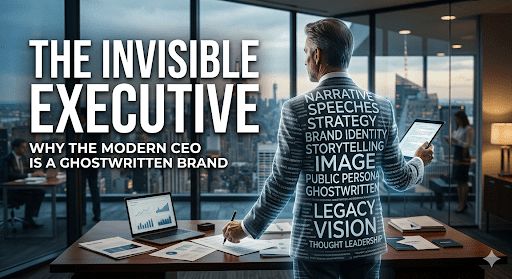
There was a time maybe not that long ago when a CEO actually wrote things.
Not polished LinkedIn manifestos. Not those oddly sterile “I’m humbled to announce…” posts. I mean real writing. Messy. Slightly uneven. Humans.
That version of leadership? It’s fading.
What’s replacing it is stranger. Cleaner. Sharper around the edges.
And, if we’re being honest… a little ghostly.
The CEO You See Isn’t Always There
Scroll through any major executive’s online presence and you’ll notice something curious.
Every post lands just right.
Every sentence behaves.
Every story loops back to a neat, inspiring takeaway.
It feels… engineered.
Because it is.
Behind many of these polished voices sits a quiet ecosystem of creators—strategists, editors, and yes, ghostwriters—shaping a narrative that sounds authentic while being anything but accidental.
Now, is that deception?
Not exactly.
It’s branding. Just taken to its logical extreme.
Authority Is No Longer Claimed—It’s Composed
Here’s the shift most people miss.
Authority used to come from doing. Build a company. Scale it. Survive a crisis or two. People listened because you’d been through the fire.
Now?
Authority is often built through expression. Through visibility. Through consistency. Through showing up again and again with ideas that feel sharp, timely, and… oddly well-written.
Too well-written, sometimes.
That’s where ghostwriting services quietly step in—not as a shortcut, but as a force multiplier.
Because let’s be honest—most CEOs aren’t sitting down at 11 PM crafting a perfectly structured narrative about leadership psychology or market timing. They’re running companies. Putting out fires. Making decisions that actually move money.
The writing? That’s handled elsewhere.
The Rise of the “Managed Voice”
There’s a term I like to use: managed voice.
It’s not fake. It’s not dishonest. But it’s curated—carefully shaped to hit specific notes:
- Authority without arrogance
- Vulnerability without risk
- Insight without rambling
It’s a tightrope act.
And without professional help, most people fall off.
This is where things get interesting. Because the modern CEO isn’t just building a company anymore—they’re building a narrative layer that sits on top of it.
A second identity. One that lives online. One that scales faster than any product ever could.
Books Became Business Cards (Just More Expensive)
Let’s talk about books.
Not the romantic idea of locking yourself away for six months, pouring your soul into 80,000 words. That’s rare now.
Today, a book often functions as a signal.
A credibility marker.
A positioning tool.
A very sophisticated handshake.
And guess what?
Most of these books aren’t written alone.
That’s where ebook editing services and amazon publishing services enter the picture—not as optional add-ons, but as part of a pipeline. A system designed to turn raw ideas (sometimes just voice notes) into something that looks, reads, and sells like a finished product.
Clean. Structured. Market-ready.
You don’t just “write a book” anymore.
You assemble one.
A Slight Tangent—But Stay With Me
Ever notice how some executives suddenly become… prolific?
One year, silence.
The next? Weekly posts. Articles. A book announcement. Podcast appearances.
Did they suddenly discover a hidden love for writing?
Maybe.
Or maybe they finally decided to treat content the same way they treat everything else—by building a team around it.
We don’t question a CEO for not designing their own logo. Or coding their own product. Or running their own ads.
So why do we expect them to write every word themselves?
The Quiet Power of Professional Storytelling
Here’s the part most people underestimate.
Good ghostwriting isn’t about writing for someone.
It’s about extracting what’s already there—then sharpening it until it cuts clean.
A skilled writer doesn’t replace your voice. They tune it. Adjust the rhythm. Remove the friction.
Suddenly, your ideas land harder.
They travel further.
They stick.
And when paired with strong ebook editing services, something subtle happens: your message stops feeling like a draft and starts feeling… inevitable. Like it was always meant to sound that way.
The Illusion of Effortlessness
There’s a reason the best executive content feels easy to read.
Because the effort is hidden.
Completely.
You don’t see the revisions. The restructuring. The quiet back-and-forth that turns a rough idea into something precise. That invisibility? That’s the whole point.
Which brings us back to the “ghost” in ghostwriting.
The writer disappears.
The brand remains.
And if done well, no one questions it.
So… Is This a Problem?
Depends on how you look at it.
If you believe leadership must be raw and unfiltered, then yes—this trend might feel a little unsettling.
But if you see communication as a skill—one that can be refined, supported, and yes, outsourced—then it makes perfect sense.
Because here’s the uncomfortable truth:
The market doesn’t reward effort.
It rewards clarity.
And clarity often requires help.
Where Most CEOs Get It Wrong
Not all ghostwritten brands work.
Some feel hollow. Overproduced. Like a speech written for an audience that doesn’t exist.
You’ve seen those posts. They sound impressive for about three seconds… then vanish from your memory completely.
Why?
Because they lack tension. Specificity. Real thought.
Throwing amazon publishing services at a weak idea won’t fix it. Neither will editing. Or distribution.
The core still matters.
The thinking still matters.
Ghostwriting can amplify substance—but it can’t create it out of thin air.
The Best Ones Feel… Slightly Unpolished
Here’s a paradox.
The most effective ghostwritten content doesn’t feel perfect.
It has edges. Small imperfections. Moments where the sentence runs a bit long or the idea takes an unexpected turn.
That’s what makes it believable.
That’s what keeps it human.
Ironically, it often takes more skill to create that controlled imperfection than to produce something clean and generic.
The Future CEO Might Never Write Alone Again
We’re heading toward a world where writing—at least at the executive level—is rarely a solo act.
And honestly? That’s fine.
Because the role of a CEO isn’t to be a writer. It’s to be a thinker. A decision-maker. A direction-setter.
If a team can help translate those thoughts into something sharper, clearer, and more impactful… why wouldn’t they?
The real risk isn’t using ghostwriting services.
It’s using them poorly.
One Last Thought (Before You Scroll Away)
Next time you read a perfectly crafted post from a CEO, pause for a second.
Not to question its authenticity—but to appreciate the machinery behind it.
Because what you’re seeing isn’t just a person.
It’s a collaboration.
A voice that’s been shaped, refined, and released into the world with intention.
Invisible, yes.
But far from accidental.
If you’re thinking about building that kind of presence—something that actually sounds like you, just sharper—you might want to explore how structured content and professional support can reshape your voice.
And that’s the real shift, isn’t it?
The modern CEO doesn’t just lead a company.
They lead a narrative.
Even if they’re not the one typing every word.


Amilia Brown is a seasoned business writer & strategist who simplifies complex business concepts and turn them into engaging narratives. As a trusted business writer, she delivers actionable insights with precision.




 Indian CEOs in America: A Detailed Account of the Masterminds
  Add Boosters to Your Business Wheels in 2025 with These 5 Strategies
  6 Skills Every Business Leader Should Possess and Hone
  The Vital Role Of Plastic Tubing In Our Medical Infrastructure
  Why Treating Your Employees like Assets and Investing in Them is a Good Idea