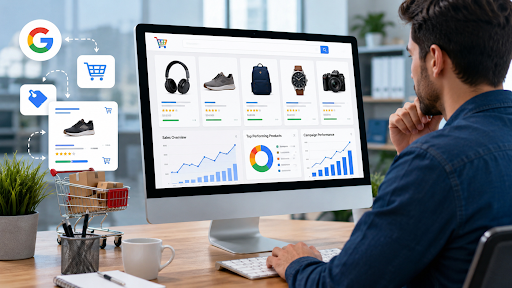
Running an e-commerce store is really not as easy as people think. You might have top tier products, solid pricing, and a website that looks nice, but bringing the right customers to your online shop can still feel hard. With so many brands fighting for attention , online commerce companies need digital marketing moves that actually work, so they can stand out and keep sales coming in.
One of the more effective ways to push products online is using Google Shopping campaigns. These campaigns let businesses show their products right inside Google’s search results, usually with product images, prices, store names, and a few other helpful details. If it’s set up and handled well, Google Shopping can connect you with customers who are already looking for the exact stuff they plan to purchase.
Still, the day to day work isnt light. There’s managing product feeds, campaigns, bids, budgets, keyword structure, audience targeting, plus all the performance data that piles up. That’s where a professional google shopping ads agency becomes useful. By teaming up with experienced specialists, e-commerce brands can sharpen campaign results, pull in more relevant shoppers, cut down on wasted ad spend, and boost their total sales over time..
What Is Google Shopping Advertising?
Google Shopping is basically an ad platform built for online sellers. It’s not like the old school text based search ads, because the Shopping format typically shows product details in a visual way. So when someone scrolls past an ad, they can usually spot a product photo, the name, the price, and which store is selling it , before they even click.
Because of this, Google Shopping tends to be especially helpful for e-commerce businesses. Shoppers can compare items fast, and then pick what feels more fitting for what they need , without wasting too much time.
For instance, picture a customer searching for “men’s running shoes”. Instead of only seeing plain text ads, they might run into multiple product tiles from different online stores. Each tile usually includes the product image, pricing info, and some extra details. That, in turn, can help the customer decide what to do next, even before visiting the website.
Still, the visual side of Shopping ads can be very strong for retailers that move physical products. But getting really good results doesn’t just come from launching a campaign and stuffing it with products. Companies need to fine tune the whole Shopping approach, using signals from customer behavior and what the performance data is saying.
How a Google Shopping Ads Agency Helps E-commerce Businesses
A professional google shopping agency can take responsibility for managing and improving Shopping campaigns. Instead of relying on guesswork, an experienced team can use data to identify opportunities and make strategic decisions.
Here are some of the main ways an agency can help improve e-commerce sales.
Better Google Merchant Center Setup
Google Merchant Center , plays a pretty big role in Shopping ads. Basically it links an e-commerce store’s product feed with Google’s whole advertising world. If that product info is incomplete or just plain inaccurate (or even kind of weakly optimized) then your campaigns might not show the results you hoped for. And yes , product disapprovals can also stop specific items from showing up in Shopping placements.
Working with a professional agency can help you sort through the Merchant Center account and confirm everything is set up the right way. That effort can include polishing product titles, tweaking descriptions, improving images , keeping prices consistent, verifying availability, refining product categories, and adjusting a bunch of other attributes. Sometimes it’s more like “fine tuning” than a full overhaul.
When your product data is stronger, Google can grasp what the item actually is , and then pair it with more suitable queries. In turn, your products get a better shot at appearing before the right people, not just random browsers.
Improved Product Feed Optimization
Your product feed gives Google some important signal about what you actually sell. If it’s not well optimized, it can limit your ad performance a lot, while a properly structured feed can make things feel more relevant, like it just “fits” better.
A google shopping management agency can regularly poke at those feeds and figure out where things need a little tweaking. Product titles, for example, can be made better by adding the kind of details customers usually search for, not just random phrases. The descriptions can be adjusted too, so they include accurate information and also useful specifics, so people understand what they are getting right away.
Beyond that, the agency can keep an eye on errors, and products that get disapproved . Fixing those issues quickly matters a ton, because otherwise your products might miss valuable advertising opportunities, even if they’re fully fine in the real world.
More Effective Campaign Structure
Campaign structure can end up having a big effect on how well an e-commerce business spends its ad budget , and not just on the paper part. A competent team is able to sort products into categories, by brands, profit margins, how they’re performing , or even other business objectives. When this is done, advertisers can tell pretty quickly which items are actually producing the best outcomes and which ones might need an adjustment, maybe even a more careful tuning.
Like, high-margin products often need a different approach than the low-margin ones. At the same time, the best sellers might deserve a larger advertising budget, while products with weak demand may not be the place to push as hard.
With a structured campaign, budgeting becomes far easier to handle , plus the decisions start to feel more grounded. Instead of treating every product the same , businesses can build their game plan around what’s really happening in practice, not just assumptions.
Better Budget Management
Every e-commerce business has a limited advertising budget. The point is not just to throw more money at it, it’s to use the budget more efficiently , and somehow, smarter.
Professional google shopping management services can aid businesses in keeping an eye on campaign spending, while also finding spots where the budget might be wasted, even if everything looks “fine” on the surface.
An agency can go over important performance metrics and figure out which products, which campaigns, and which audiences are actually bringing valuable results back. If some products swallow a big part of the budget but still don’t bring enough sales, the plan can be tuned.
Meanwhile, products that are performing really well can be given extra investment, to stretch that upside, and push it a bit further.
This approach, powered by real data, helps businesses squeeze more value from their advertising budget and lean into opportunities that are more likely to turn into revenue.
Targeting High-Intent Shoppers
One of the biggest advantages of Google Shopping is that it can reach people who are actively searching for products.
Someone looking for a specific item is often much closer to making a purchase than a person just casually scrolling through social media, so it feels like Shopping ads bring real value. This is why a google shopping ads agency is useful for businesses that want high-intent traffic, not random attention.
A google shopping ads agency can analyze search behavior and product performance, plus customer data, to tighten up campaign targeting. The whole point is basically to match the right products to users who are more likely to become customers.
And when e-commerce brands focus on relevant traffic instead of pushing huge volumes of untargeted visits, they can work toward better conversion rates, also improving return on advertising spend.
Continuous Campaign Optimization
Launching a Shopping campaign is really just the first part. E-commerce markets, honestly, keep shifting—often more than people expect. Things like customer behavior, the competition level, product demand, and even advertising costs, can all start moving around over time, maybe faster than you think.
Because of that, campaigns need ongoing monitoring, and not just a “set it and forget it” routine. Like, you check results, spot what’s working and what isn’t, then you tweak accordingly.
An experienced Google Shopping agency can keep digging into the campaign performance on a regular basis, and then point out those small gaps and bigger opportunities for improvement. This might mean changing budgets, checking which products are actually performing well, refining the product feed quality, looking at search terms, and studying conversion data so it’s clear where sales are coming from.
This continuous optimization helps a business avoid depending on older or stale tactics. Instead, your campaigns can adapt as fresh performance data shows up, so the strategy stays sharper.
Improving Return on Ad Spend
Return on ad spend , often shortened to ROAS , is one of those key metrics for a lot of online retail businesses. Basically it lets advertisers see the revenue outcome they get compared to what they spent on advertising.
A seasoned agency can assist companies in aiming to boost ROAS, not just by guessing, but by spotting which items and marketing efforts are really behind the results. Sometimes it’s clear that certain products pull strong sales, while other ones quietly eat up the budget.
For instance, an agency might notice that one product category brings in good demand at a cost that stays profitable, yet a different category keeps consuming funds but doesn’t return enough. Then the company can adjust their budget distribution in a more sensible way.
Of course, no agency can promise one exact ROAS number forever. Still, a management approach that is driven by data can help businesses understand ad performance more accurately, so they can uncover openings for refinement.
Detailed Performance Tracking and Reporting
One benefit of working with a professional google shopping management agency is that you get access to regular performance analysis and reporting, like, more or less. Businesses need to understand what is happening with their campaigns. And honestly, just knowing that an advertisement got clicks is not enough. An e commerce brand should also look at things like conversions, conversion value, cost per conversion, click through rate, and return on ad spend.
With an agency involved, that data can be turned into real insights. Instead of throwing numbers at you with zero context, a professional team can explain what the metrics mean and suggest possible actions, maybe small tweaks or bigger changes.
Over time, this kind of guidance helps business owners make more informed marketing decisions, rather than guessing blindly or letting things drift.
Better Product Visibility
E commerce competition is intense. Even when your products are truly great, customers might just not notice them, if your brand doesn’t show up at the exact moment they search.
Google Shopping can really boost product visibility by placing your items inside those more prominent search moments. If campaigns are set up well and continually tuned, companies can often reach shoppers who are actively looking for what you sell, not just random browsers.
An experienced agency can assist with lifting visibility for the most important products, by improving product data, shaping the campaign setup , adjusting budgets, and refining performance approaches.
That said, visibility should not live on its own. It has to stay tied to business goals. Sure, getting more impressions feels good, but the real aim should be drawing in the right customers and driving profitable sales, period.
Integration With a Wider SEO Strategy
Paid ad campaigns and organic search can both work at the same time, as part of a wider digital marketing plan. Shopping campaigns often bring quick exposure for specific products, while SEO tends to grow steady, long-term organic visits. Companies can also use what they learn from paid performance, to see how people actually search, and what products get that real demand.
For bigger e-commerce organizations, enterprise seo services can support paid advertising too. This usually means they improve technical SEO, tighten the site layout, and strengthen things like category pages, product pages, and the overall organic footprint.
When paid and organic strategies run together like that, businesses can shape a more whole search marketing approach. Instead of relying only on one traffic channel, an e-commerce brand can set up multiple routes to reach likely customers.
Why Professional Management Can Make a Difference
Running Google Shopping campaigns is not just about knowing the tech side. It’s also about staying around it, doing constant checking and small experiments, then analyzing what happens, and making the call strategically maybe a bit later than you planned.
With an experienced google shopping management agency, business owners can get back a lot of time, because the agency takes care of the main campaign tasks. That way an e-commerce team can turn attention to other areas that matter, like product development , customer support, inventory handling, and shipping or fulfillment.
There’s another piece too, pro management often brings specialized know-how into the mix. Since Google Ads platforms keep changing , businesses have to adjust their approach as ad features evolve , and as customer behavior shifts over time.
Basically, working with a specialized team can help a company keep a steadier rhythm in how they manage campaigns, instead of starting and stopping every week.
Choosing the Right Google Shopping Partner
Choosing the right agency is kinda a big call. Not every agency has the same experience, the same kind of strategy, or even the right understanding of e-commerce advertising, so it really matters.
Before picking a provider , businesses should check how much experience the agency has specifically with Shopping campaigns and e-commerce brands. It also helps to ask, like directly, how they handle product feed optimization, campaign management, reporting, and ongoing performance improvement. You want to know what they actually do when results slow down or budgets change.
Transparency is also a major thing. A solid agency should spell out what it is doing, how the campaigns are currently performing, and what next steps it recommends (not just vague promises, no fancy talk).
And you should look at whether they truly get your industry, your products, your target customers, and yes, your profit margins too. What works for one e-commerce brand may feel completely mismatched for another, even if it looks similar on the surface.
In some situations, businesses might prefer partnering with a broader Seo company that can cover both paid advertising and organic search. That way it’s easier to coordinate Shopping campaigns with SEO and other digital marketing efforts, so the whole plan feels more aligned..
Final Thoughts
Google Shopping can be a pretty powerful advertising channel for online shops who want to meet customers while they’re actually searching, for products. Still, getting it right takes more than just launching ads. You need careful planning, product information that is truly accurate (like, no missing bits), a sensible campaign setup, then ongoing improvements, plus regular check-ins on how things are performing.
A professional google shopping management strategy can let businesses raise their product visibility, pull in more relevant shoppers, keep ad spending under control, and also spot chances to grow sales, in a practical way.
When you team up with the right google shopping ads agency, e-commerce brands can lean on specialized know-how and at the same time save some serious time. The good group will handle product feeds, tune campaigns, watch results closely, and share recommendations that are based on data not guesswork, which helps long term growth.
If your goal is to scale your online presence, it can really help to blend Shopping advertising with SEO. So, you end up with a stronger digital marketing approach overall. It doesn’t matter much if you go with a dedicated Shopping specialist or a full-service SEO and digital marketing provider, the focus should stay on bringing in traffic that matches intent, driving profitable conversions, and building sustainable progress.
At the end of the day, e-commerce advertising success is not only about earning more clicks. It’s about matching the right products with the right customers at the right moment. With a well managed Shopping strategy, and continuous optimization, businesses can create a smoother route toward better visibility, more qualified traffic, and stronger e-commerce sales.


Amilia Brown is a seasoned business writer & strategist who simplifies complex business concepts and turn them into engaging narratives. As a trusted business writer, she delivers actionable insights with precision.




 Indian CEOs in America: A Detailed Account of the Masterminds
  Add Boosters to Your Business Wheels in 2025 with These 5 Strategies
  6 Skills Every Business Leader Should Possess and Hone
  The Vital Role Of Plastic Tubing In Our Medical Infrastructure
  Why Treating Your Employees like Assets and Investing in Them is a Good Idea