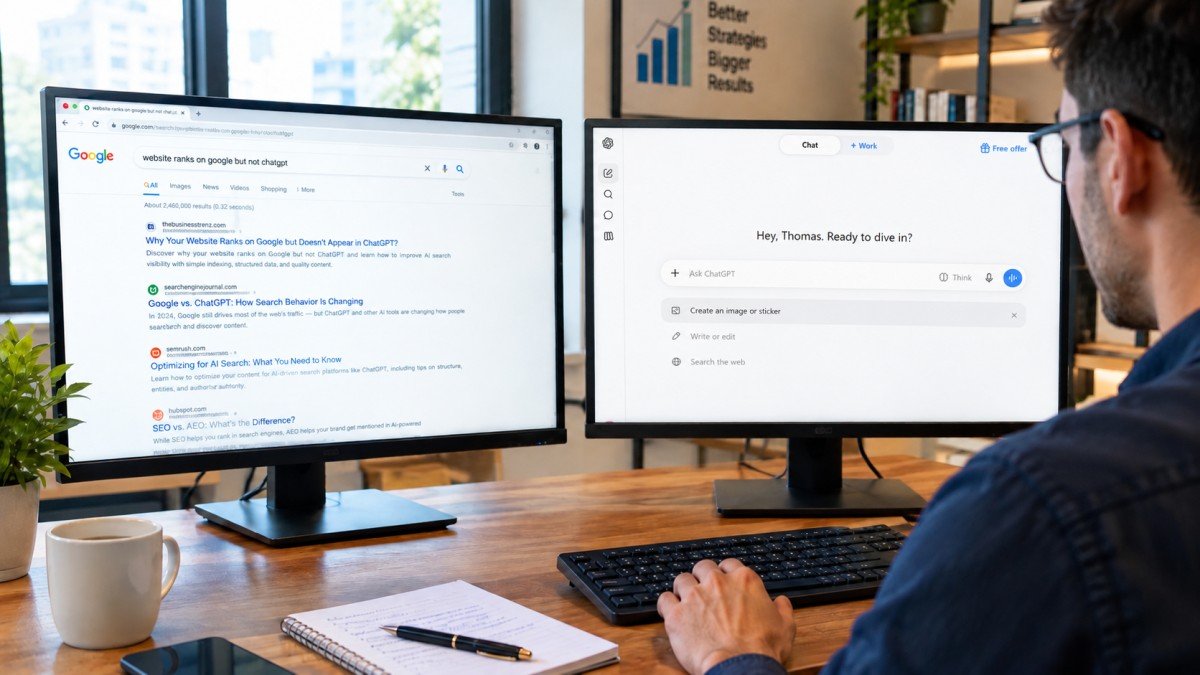
You’ve done everything right. Your site ranks on page one, and your traffic looks healthy in Search Console. Your SEO agency sends green dashboards every month. But when potential customers ask ChatGPT the same question–your name never comes up.
If your website ranks on Google but not ChatGPT, it does not necessarily mean the website has poor SEO. It may mean the site’s content isn’t structured, supported, or discoverable for AI-driven retrieval.
For two decades, ranking on Google was visibility. That equation has changed. A brand can dominate traditional search and still be functionally invisible in AI answers, where a growing share of buyers now do their research.
Google Rankings and ChatGPT Visibility Are Different Approaches
Google and AI answer engines are solving two different problems. Google retrieves, ranks, and displays links while AI engines generate an answer first, then select sources to support it. To better understand how AI-powered search works, remember that a page ranking highly for a keyword does not guarantee it will be cited in AI search results.
Example:
Understanding how generative AI in SEO is transforming search reveals why a brand can dominate traditional search yet remain functionally invisible inside AI-generated answers. A web development company may rank 3 for “WooCommerce development services in Kolkata,” while another company with a lower Google ranking may be mentioned more often because its website clearly explains its services, expertise, industries, and project experience.
How to Optimize Content for ChatGPT?
ChatGPT relies heavily on its training data rather than search engine rankings when generating answers. As a result, its cited sources often differ significantly from top Google search results. Refer to the points to learn more.
- Optimize for Bing — not just Google
ChatGPT Search uses the Bing index as its live retrieval layer. Make sure Bing can discover and index your pages, while OAI-SearchBot is allowed to crawl them. Ensure your pages are fully indexed on Bing. This single technical step has an outsized impact on ChatGPT visibility.
- Make Easy Content
To improve website visibility in ChatGPT, instead of relying on repeated keywords and AI-generated content, create clear, entity-focused content around specific services, industries, locations, technologies, case studies, and areas of expertise. The content should include clear headings, descriptive language, and meaningful internal links to rank in ChatGPT.
For Instance: Instead of one generic “Web Development Services” page, create clearly organized, people-first content pages explaining the technical approach with relevant examples.
- Apply E-E-A-T
Experience, Expertise, Authoritativeness, and Trustworthiness matter even more for ChatGPT citations than traditional search. Include credentials, cite real data and studies, earn backlinks from high-authority publications, and keep your content factually accurate and updated.
For Instance: A web development agency can support its expertise with a detailed case study showing how it improved a client’s website speed.
- Work with an SEO Expert

Experienced search engine optimization specialists and AI search optimization specialists develop a strategy that balances conventional search optimization and visibility generated by AI. Applying proven LLM optimization tips helps your website keep up with changing digital trends. Working with an SEO expert can help you build a strategy that combines traditional search optimization with AI-driven visibility. Google SEO and ChatGPT SEO share some fundamentals, but they differ in how content is discovered, understood, and surfaced. Heres how
| Factor | Google SEO | ChatGPT SEO |
| Goal | Rank in search results | Get mentioned or cited in answers |
| Focus | Keywords, relevance, links | Clear answers, expertise, context |
| Key signals | Content, backlinks, technical SEO | Relevance, credibility, retrievability |
| Measurement | Rankings, clicks, traffic | Mentions, citations, referrals |
- Implement (schema markup)
AI answer engines don’t read web pages the way humans do. They rely on structured data. JSON-LD schema helps AI models map relationships between entities and understand your content at a machine level. By utilizing FAQ Page, Article, Organization, and Service schemas, you give AI models explicit context about your page’s focus, authority, and real-world background. Neglecting this machine-readable context is one of the core reasons for the AI visibility gap.
For instance: A web development agency can use Organization schema to verify its business entity details, while using Service schema on a page like “WooCommerce Development Services” to help ChatGPT recognize the exact scope, location, and nature of the services offered.
- Brand mentions across the web
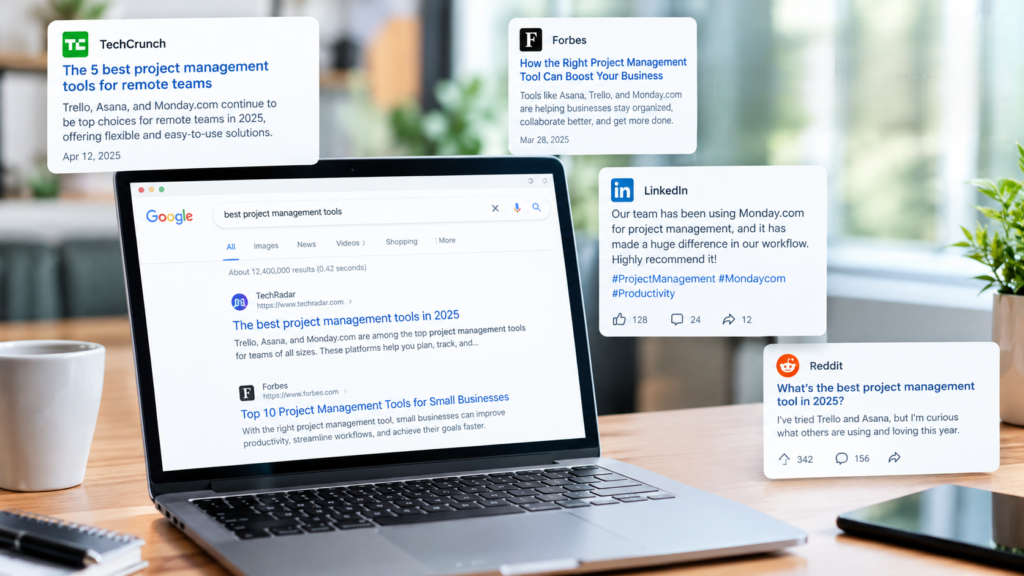
ChatGPT’s training data is shaped by how frequently and credibly your brand is cited across news articles, industry blogs, and directories. Make sure your brand is mentioned consistently on relevant and trustworthy websites, not just your own. A proactive PR and link-building strategy that earns mentions on high-authority sites helps AI models recognize and trust your brand.
For Instance: A digital marketing agency may be mentioned in a local business publication for completing a successful SEO campaign. This helps build credibility and makes it easier for ChatGPT to find websites.
- Your Best Answer Is Buried Mid-Page
Top pages achieve their rankings with the help of SEO experts to maximize content. AI tools often look for clear, direct answers they can easily use in a response. If the main answer is hidden deep inside a long paragraph, it may be harder to retrieve. Use relevant keywords and well-researched sentences for better visibility.
For Instance: Under “How long does SEO take?”, start with: “SEO typically takes 3–6 months to show meaningful results.” Then explain the factors that affect the timeline. This clear structure improves ChatGPT search visibility for websites.
A Combined Approach
The most effective approach you can take is to unite the two worlds, continuing to develop strong foundations of SEO while modifying your content to align with AI-based tools.
Final Takeaway
The high-ranking websites that are featured in Google are not always included in ChatGPT since their operations are different. A strong Google ranking is valuable, but it is only one part of modern search visibility. If your website is technically accessible and consistently demonstrates expertise, it gives both traditional search engines and AI systems useful information to understand and potentially surface.
FAQ
1. In what ways does ChatGPT decide which websites to cite?
In the case of ChatGPT, content’s topical authority matters the most. ChatGPT can consider factors such as relevance, content quality, credibility, freshness, and so on. A high Google ranking alone does not guarantee a citation.
2. Does SEO help with ChatGPT visibility?
Traditional SEO helps with ChatGPT visibility because ChatGPT uses conventional web search engines (like Bing) to retrieve real-time information. Additionally, clear content structure and internal linking can improve your chances of being discovered and used by AI search systems.
3. Does structured data help websites appear in AI search?
Structured data helps websites appear in AI search by giving AI models clear, machine-readable context about entities and specific details on a page. However, it does not guarantee that ChatGPT or another AI search system will cite the page.
4. Does ChatGPT use Google’s index?
Reports show that ChatGPT relies on Google’s index and search results for certain queries, despite official statements highlighting its partnership with Microsoft Bing
5. How To Find That AI crawlers are blocked on my site?
Tools such as Google Search Console and Bing Webmaster Tools can help you check general crawling and indexing, while OpenAI’s crawler documentation explains which bots are used for ChatGPT search.


Amilia Brown is a seasoned business writer & strategist who simplifies complex business concepts and turn them into engaging narratives. As a trusted business writer, she delivers actionable insights with precision.




 Indian CEOs in America: A Detailed Account of the Masterminds
  Add Boosters to Your Business Wheels in 2025 with These 5 Strategies
  6 Skills Every Business Leader Should Possess and Hone
  The Vital Role Of Plastic Tubing In Our Medical Infrastructure
  Why Treating Your Employees like Assets and Investing in Them is a Good Idea