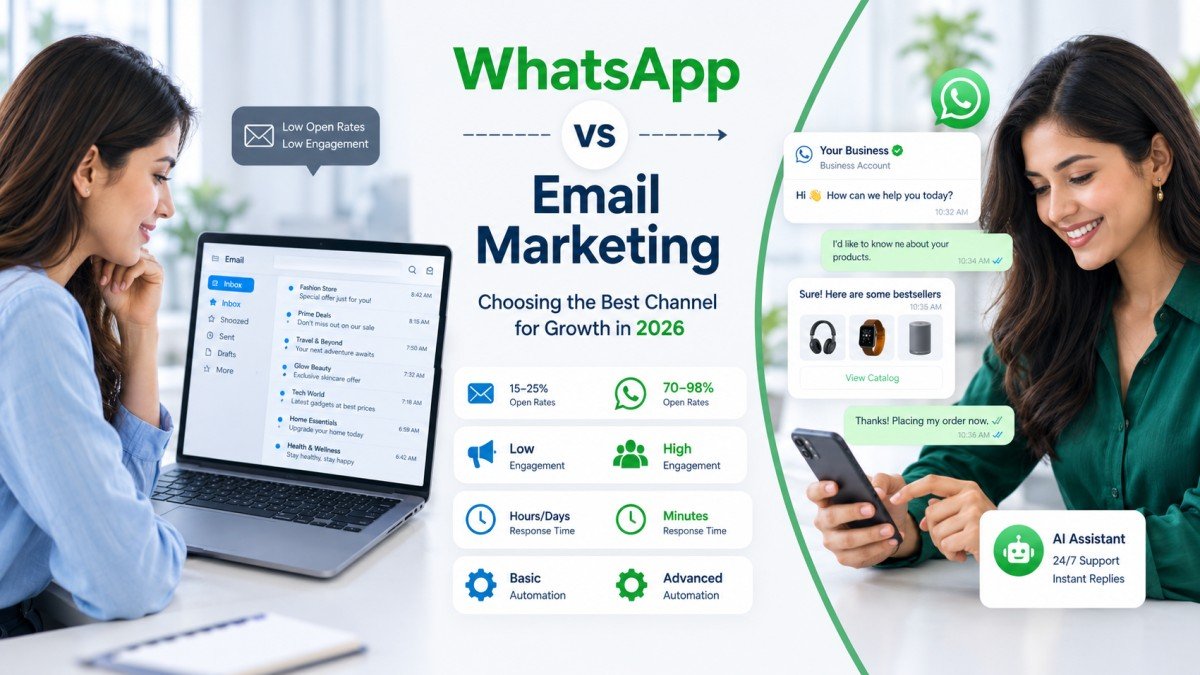
You have a great offer, a solid customer list, and a marketing plan. Then you wonder if you should send that next message on WhatsApp or email.
As a marketing expert, I wouldn’t treat this as a simple channel-vs-channel battle. Both platforms do different jobs well. The smarter approach is to match the channel to where your customer is in the buying journey. That’s especially important when you’re planning WhatsApp vs. email marketing for customer retention, because the message that works before a purchase may not work after it.
So, let’s break down the customer journey stage by stage and see where each channel fits.
WhatsApp vs. Email Marketing: Understanding the Difference
Think of WhatsApp as the quick conversation and email as the detailed letter.
WhatsApp is built around short, direct, two-way communication. It works well when you want a customer to respond, click, book, ask a question, or act quickly.
Email gives you more room. You can explain a product, share a newsletter, send a guide, or build a longer nurture sequence without fighting for attention in a chat window.
For context, Mailchimp’s current benchmarks show an average email open rate of 35.63% across its dataset, with a 2.62% average click rate. However, benchmarks vary significantly by industry, audience quality, and campaign type.
That’s why the best marketing channel—WhatsApp or email—depends on your objective, audience, and customer journey stage.
WhatsApp Marketing vs. Email Marketing Across the Customer Journey
Knowing how to balance both channels across different touchpoints is key. According to Spotler’s guide, channel intent differs.
| Customer journey stage | ||
| Awareness | Quick introductions, click-to-chat campaigns | Newsletters, educational content |
| Consideration | Product questions, recommendations, conversations | Guides, comparisons, case studies |
| Conversion | Offers, reminders, booking links | Abandoned-cart and nurture emails |
| Purchase | Order updates and confirmations | Receipts, detailed purchase information |
| Onboarding | Quick tips and support | Detailed guides and tutorials |
| Retention | Offers, reminders, loyalty messages | Newsletters, product updates |
| Advocacy | Review and referral requests | Testimonials and referral campaigns |
The important point? You don’t have to choose one channel for your entire funnel.
Awareness: Start With Attention
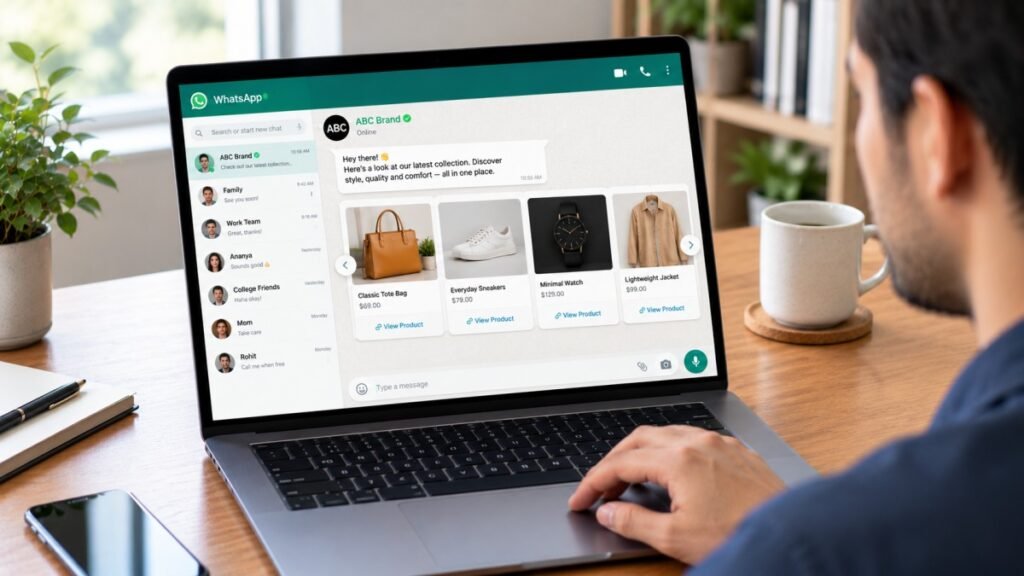
At the awareness stage, your customer may not know much about your business yet.
Email is useful when you’re building a subscriber base through valuable content. A newsletter, industry insight, or useful guide can introduce your brand without immediately pushing a sale.
WhatsApp can work well when the customer has already chosen to start a conversation with you. This makes WhatsApp vs. email for customer acquisition less about reach and more about permission and intent.
WhatsApp Business requires businesses to obtain opt-in permission before sending messages, and Meta also requires businesses to respect opt-outs.
Consideration: Let Customers Ask Questions
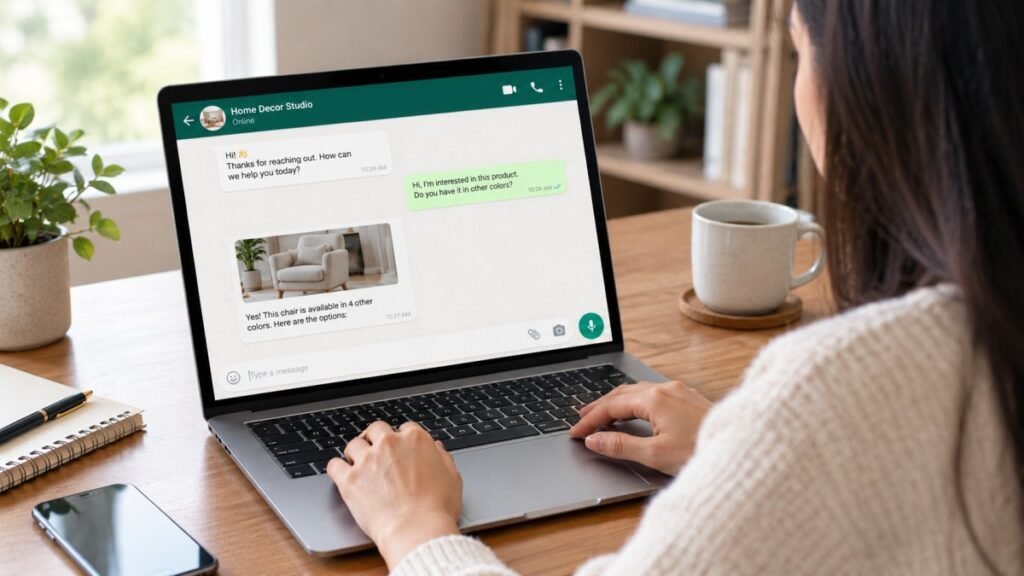
This is where the WhatsApp customer journey becomes particularly useful.
Suppose someone is considering a ₹20,000 product. They may want to know about delivery, warranty, sizes, features, or payment options. WhatsApp lets them ask and get an answer in the same conversation.
Email still has a major role here. Your email customer journey can include comparison guides, FAQs, case studies, testimonials, and educational content.
In simple terms, use WhatsApp when the customer wants a conversation. Use email when they need more information to consume at their own pace.
Conversion: Reduce the Friction
At the conversion stage, timing matters.
A WhatsApp reminder can nudge someone who asked about a product but didn’t purchase. It can also share a booking link, payment option, product recommendation, or limited-time offer. Email can handle abandoned-cart reminders and longer nurture sequences effectively.
This is where an email vs. WhatsApp marketing funnel should work together rather than compete. WhatsApp can create the immediate push, while email can provide the additional information needed to make the decision.
Purchase: Keep Communication Useful
Once the customer buys, your communication should become more practical.
WhatsApp is excellent for short updates such as order confirmations, appointment reminders, delivery notifications, or quick support. Email remains valuable for receipts, invoices, detailed product information, warranty details, and information customers may need to find later.
This is also where your WhatsApp marketing strategy needs discipline. Don’t turn a useful order-update channel into a never-ending promotional feed.
WhatsApp or Email Marketing in the Customer Journey: What About Retention?
Retention is where many businesses get the balance wrong. They either send too many WhatsApp messages or bury loyal customers under endless emails. Your job is to give customers a reason to stay connected.
WhatsApp works well for:
- Replenishment reminders
- Loyalty rewards
- Personalized offers
- Appointment reminders
- New product alerts
- Quick feedback requests
Email works well for:
- Monthly newsletters
- Educational content
- Product updates
- Re-engagement campaigns
- Customer stories
- Detailed loyalty communications
This is the practical side of WhatsApp or email for customer engagement. Use the channel that matches the customer’s expected behavior.
WhatsApp Chatbots vs. Email Drip Campaigns
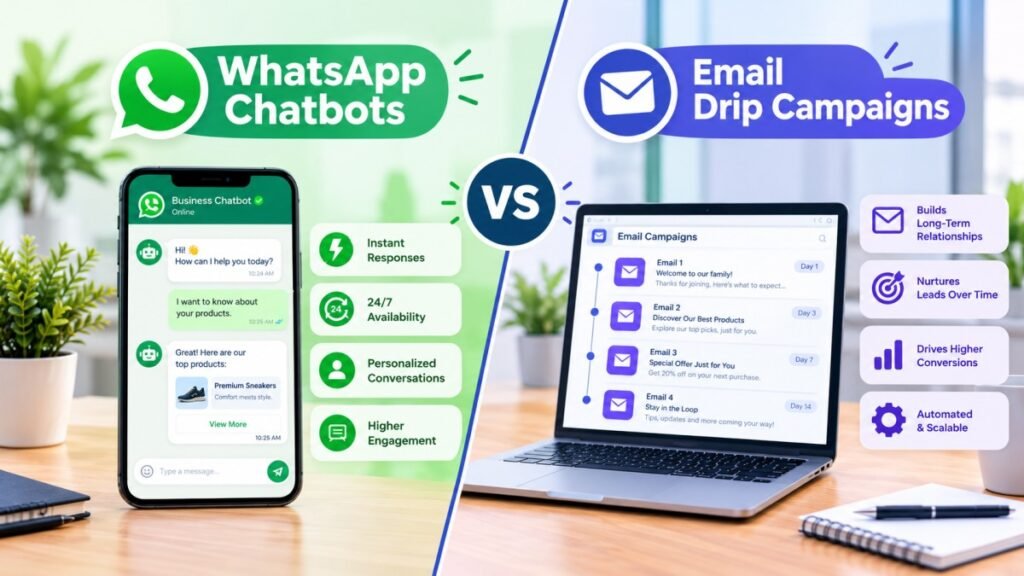
Automation makes both channels more powerful.
A WhatsApp chatbot can answer common questions, recommend products, collect basic information, or route a customer to a human agent. Meta’s WhatsApp Business policy also requires businesses using automation to provide a clear escalation path to human support or another support channel.
An email drip campaign works differently. You can create a sequence based on actions such as signing up, downloading a guide, viewing a product, or making a purchase.
So, when comparing chatbots and drip campaigns, think about conversation versus nurture.
If your customer needs quick answers, WhatsApp automation can help. If your customer needs a sequence of useful information over several days or weeks, email automation can be a better fit.
WhatsApp Marketing vs. Email Marketing For Small Businesses
For a small business, running 2 channels can sound like double the work. It doesn’t have to be. Start by mapping your customer journey. Ask yourself:
- How do customers first discover us?
- What questions do they ask before buying?
- What usually delays a purchase?
- What information do customers need after buying?
- Why do existing customers come back?
According to Kenneth Ntende from Trembi, communication needs to be assigned to the channel that makes the most sense.
For example, a salon might use WhatsApp for appointment reminders and quick offers, while email handles monthly beauty tips. An ecommerce brand could use WhatsApp for delivery updates and time-sensitive promotions, while email handles product education and newsletters. As AiSensy clarified, the salon has a higher chance of engagement through this WhatsApp strategy.
That’s a much more practical approach to WhatsApp vs. email marketing strategy for customer engagement than sending the same message everywhere.
WhatsApp and Email Marketing Comparison: What Should You Measure?
Don’t judge channels purely by open rates. Track the numbers that connect communication to business outcomes:
- Click-through rate
- Reply rate
- Conversion rate
- Cost per conversion
- Revenue generated
- Unsubscribe or block rate
- Repeat purchases
- Customer lifetime value
Also remember that benchmarks aren’t promises. A highly engaged, permission-based audience can perform very differently from a cold or poorly segmented list.
For email, permission and unsubscribe management are essential. Mailchimp notes that marketing emails should be sent to subscribed contacts and include an unsubscribe option.
WhatsApp requires the same basic respect for customer permission. Meta specifically says businesses should make the purpose of opt-in clear and honor requests to stop receiving communications.
WhatsApp vs. Email Marketing – Which is Better?
There’s no universal winner. WhatsApp is particularly useful when you need speed, conversation, quick responses, and direct action. Email is specifically useful when you need depth, education, documentation, and structured nurturing.
The strongest strategy is usually not “WhatsApp or email.” It’s knowing when to use each.
Map your customer journey first. Then choose the channel that removes friction at each stage. When your communication feels timely and useful instead of repetitive, both channels can contribute to stronger customer relationships and better marketing results.
FAQs
1. Which is better for lead generation: WhatsApp or email?
Neither is strictly “better.” They just serve different roles.
- WhatsApp: Ideal for fast, high-converting lead generation. People open almost every WhatsApp message they get, making it great for instant replies, booking appointments, sending quick offers, or having interactive 1-on-1 chats.
- Email: Excels at long-term lead nurturing. It gives you space to tell stories, explain complex products, build brand trust, and educate leads without invading their personal messaging space.
2. What is the 80/20 rule in email marketing?
The 80/20 rule (based on the Pareto Principle) usually applies to email in 2 helpful ways:
- Content mix (80% value, 20% pitch): 80% of your emails should focus on helping your readers. Only 20% should directly ask them to buy something.
- Audience & revenue (20% drives 80%): In most subscriber lists, roughly 20% of your core subscribers drive 80% of your opens, clicks, and sales.
3. Do Gen Z like email marketing?
Yes. While Gen Z uses social media for entertainment, they treat their inbox as a dedicated space for commerce, promo codes, and brand updates. To reach them, keep emails brief, visual, mobile-friendly, and authentic.
4. What is the 24-hour rule on WhatsApp?
When a customer messages a business via the WhatsApp API, a 24-hour free messaging window opens. During this time, you can reply freely. Once 24 hours pass, you can only re-engage using paid, pre-approved message templates to prevent spam.
5. Is email marketing still worth it in 2026?
Yes. Email delivers high ROI because you fully own your audience (unlike social media algorithm-dependent followers), users have higher buying intent in their inbox, and modern AI tools enable hyper-personalized, high-converting messaging.


Amilia Brown is a seasoned business writer & strategist who simplifies complex business concepts and turn them into engaging narratives. As a trusted business writer, she delivers actionable insights with precision.



 Indian CEOs in America: A Detailed Account of the Masterminds
 Add Boosters to Your Business Wheels in 2025 with These 5 Strategies
 6 Skills Every Business Leader Should Possess and Hone
 The Vital Role Of Plastic Tubing In Our Medical Infrastructure
 Why Treating Your Employees like Assets and Investing in Them is a Good Idea