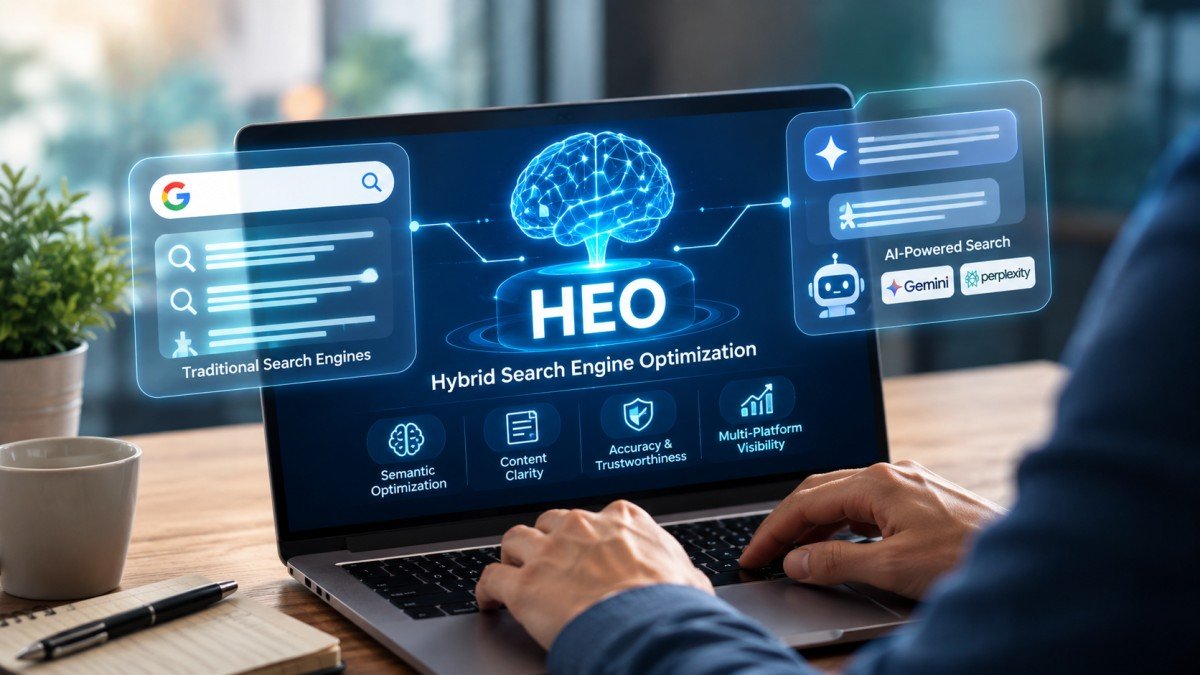
The future of search is no longer just about rankings—it’s about building an authority. As users split their searches between Google and AI platforms, businesses need Hybrid Engine Optimization (HEO) to stay visible and relevant.
SEO expert Aleyda Solis advises marketers to prioritize user intent, content quality, and technical excellence for establishing user-focused content. By following a Hybrid Engine Optimization (HEO) strategy, businesses can improve their visibility and rankings, making their content more discoverable and trustworthy, wherever users search.
What Is Hybrid Engine Optimization (HEO)?
Hybrid Engine Optimization (HEO) is the new practice of enhancing your digital content to rank and appear in traditional as well as AI-powered search results such as Gemini, Perplexity, etc. It increases semantic content optimization, helping to make your brand visible in AI searches.
This term reflects whether your content is clear, accurate, and trustworthy on all types of platforms, accelerating your search experience optimization. More people are using AI tools to find quick answers, compare products, and learn about services. HEO helps with your brand engagement, no matter how people search.
Core Pillars of Hybrid Engine Optimization
Traditional SEO Foundation
Traditional Search Engine Optimization (SEO) has long been the backbone of digital marketing. It focuses on improving a website’s visibility in search engines like Google and Bing.
Charecteristics
- Even in the hybrid model, a foundation is extremely essential. Without strong fundamentals, no amount of AI-focused content will be able to deliver fast, lasting results.
- SEO helps in creating high-quality content, earning backlinks, and improving technical performance. For years, businesses relied on these strategies to attract organic traffic and reach potential customers.
- It is considered the most important among the three pillars of HEO. It focuses on measuring success through metrics such as keyword rankings, organic traffic, click-through rate (CTR), bounce rate, and conversions using analytics tools.
AI Search Optimization

Answer Engine Optimization (AEO) deals with structuring content so that AI models can extract accurate answers directly from pages.
Charecteristics
- AEO focuses on conversational language that includes how people ask questions to AI chatbots and voice search.
- It is easily discovered by AI search platforms for its well-structured information instead of brief keyword-focused content.
- Backdated contains donot bring visibility. Regular updates to reflect the latest developments improve its value for AI-generated responses.
- It provides citation-worthy content that mentions relevant people, brands, products, places, and concepts so AI can better understand the topic.
E-E-A-T Signals
Both Google and AI language models reward content that demonstrates Experience, Expertise, Authoritativeness, and Trustworthiness (E-E-A-T)
Charecteristics
- Including detailed author bios, showcasing real-world experience, and demonstrating subject-matter expertise helps readers and search engines trust the information
- E-E-A-T also focuses on building a brand presence that is consistent and verifiable across the web.
- Hybrid engine optimization best practices include building a digital bridge between traditional SEO and AI-driven Answer Engine Optimization (AEO), ensuring visibility in both Google and AI tools.
SEO vs. Hybrid Engine Optimization
| Traditional SEO | Hybrid Engine Optimization |
| Focuses on search engines | Both search engines and AI platforms |
| Optimizes keywords | Optimizes user intent and context |
| Improves Rankings | Improves visibility |
| Targets website clicks | Targets answers, citations, and website visits |
| Measures organic traffic | Measures visibility. |
The above-mentioned table focuses on the major differences between traditional SEO and the new SEO practices that optimize content for both rank-based and answer-based discovery systems.
Top Tips for a Successful Hybrid Engine Optimization Strategy
Create Proper Content

A well-structured and informative piece of content always hooks the audience. Adding expert insights, case studies, and well-tailored information can be trusted by both readers and AI systems. Publishing original content and keeping it updated is one of the most noticeable ChatGPT citation strategies. Moreover, references from trusted organizations and statistics increase the chances of online visibility.
Establish Entity
AI models recognize entities while reading pages. Use your business logo and elaborate your profile to strengthen E-E-A-T. Furthermore, add schema markup to help search engines identify your business, authors, products, articles, and other important entities. Answer-first question optimization improves your visibility and accelerates your search results.
Follow Structured Data
A simple hybrid engine optimization hack includes using FAQ or How To. This modifies the formatting and increases your chances of earning rich results, knowledge panels, and better visibility in AI-powered search. Review structured data and check errors before publishing. High-quality content improves potential visibility across both traditional search engines and AI-powered search experiences.

Monitor HEO Performance
Start by monitoring organic traffic. In parallel, monitor AI citations; search for your target topics on ChatGPT or other AI platforms to see if your brand or content is being cited. These metrics show whether your content is still attracting users or not. Especially through conversational search optimization. Measuring HEO performance requires a blended dashboard that covers both channels.
Entity SEO Vs Keyword SEO

The table below shows the difference between entity SEO and Keyword SEO. Using both improves search visibility, builds topical authority, and increases the chances of appearing in AI-generated answers.
| Entity SEO | Keyword SEO |
| Focuses on people, brands, products, and concepts. | Focuses on specific keywords and search phrases. |
| Uses entities, schema markup, and topical authority. | Uses keyword research, placement, and on-page SEO. |
| Builds long-term authority and trust. | Improves visibility for specific search queries. |
Common Mistakes to Avoid
- Do not ignore user experience, as it is extremely essential for well-oriented and informational content.
- Keep your data updated. Using outdated statistics might hamper your visibility.
- Keep an FAQ section where you can answer questions for long-term visibility and ensure that the content is interactive.
- Do not stuff too many keywords. As it may reduce the readability of the content and bring redundancy.
Try to avoid these mistakes for long-term growth and improved visibility, and follow these hybrid engine optimization tips for better outcomes.
Mobile Moxie mentions that for entity-based SEO, explaining that search engines increasingly understand entities rather than just keywords. The core idea remains simple: create content for people first. When your content is accurate, easy to understand, and genuinely useful, it has a better chance of earning visibility.
The brands that build authority now, through great content, strong entity presence, and smart link building, will be the ones the audience will trust and recommend.
FAQ
1. How is Hybrid Engine Optimization (HEO) different from SEO?
Traditional SEO focuses on search engine pages like Google and Bing, focusing on keywords and backlinks. Whereas HEO is suitable for AI-powered platforms, prioritizing understandable and trustworthy content. HEO helps the content to become discoverable across both search engines and AI-generated answers.
2. How do AI answer engines choose sources?
AI answer engines prioritize content that is accurate, well-structured, relevant to the user’s question, and demonstrates strong E-E-A-T.
3. Can ChatGPT recommend my website?
Although there is no guarantee that ChatGPT will recommend a particular site, publishing original, high-quality, and trustworthy content can improve your website’s visibility.
4. How do entities improve AI rankings?
Entities help AI systems understand the people, brands, products, places, and concepts mentioned in your content for a better understanding of your content’s context.


Amilia Brown is a seasoned business writer & strategist who simplifies complex business concepts and turn them into engaging narratives. As a trusted business writer, she delivers actionable insights with precision.



 Indian CEOs in America: A Detailed Account of the Masterminds
  Add Boosters to Your Business Wheels in 2025 with These 5 Strategies
  6 Skills Every Business Leader Should Possess and Hone
  The Vital Role Of Plastic Tubing In Our Medical Infrastructure
  Why Treating Your Employees like Assets and Investing in Them is a Good Idea