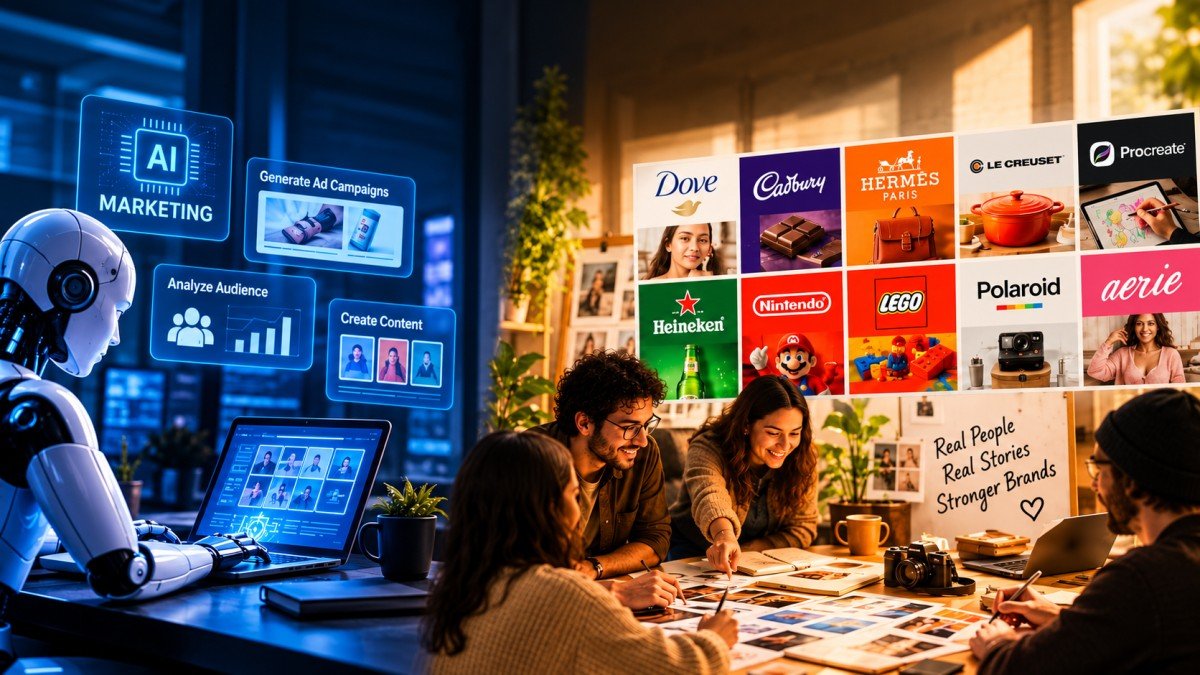
AI is everywhere in marketing right now. It writes copy, generates images, suggests campaign ideas, and apparently wants to attend every creative meeting, too. But here’s the interesting bit: some of the world’s biggest brands are deliberately going the other way.
From beauty and fashion to beer, gaming and photography, these brands are showing that you can still build attention with people, craft, ideas, and a little old-fashioned advertising nerve.
That makes brands rejecting AI in marketing and content more than a passing trend. For some brands, saying “no” to generative AI has become part of what they stand for. And for you as a marketer, that raises a better question than how you can use AI: What can my brand do that feels unmistakably human?
Why Are Brands Choosing Marketing Without AI?

There’s an important distinction here. These brands aren’t necessarily rejecting technology altogether. Many use AI marketing tools for analytics, operations, or research. What they are protecting is the creative expression customers see.
That matters because human creativity in marketing can itself become a differentiator when consumers are surrounded by synthetic images, automated copy, and increasingly similar-looking campaigns.
A 2025 Gartner survey found that 68% of consumers frequently questioned whether online content was genuine. So, yes, AI can make marketing faster, but faster doesn’t automatically mean more memorable.
10 Brands Who Says No To AI
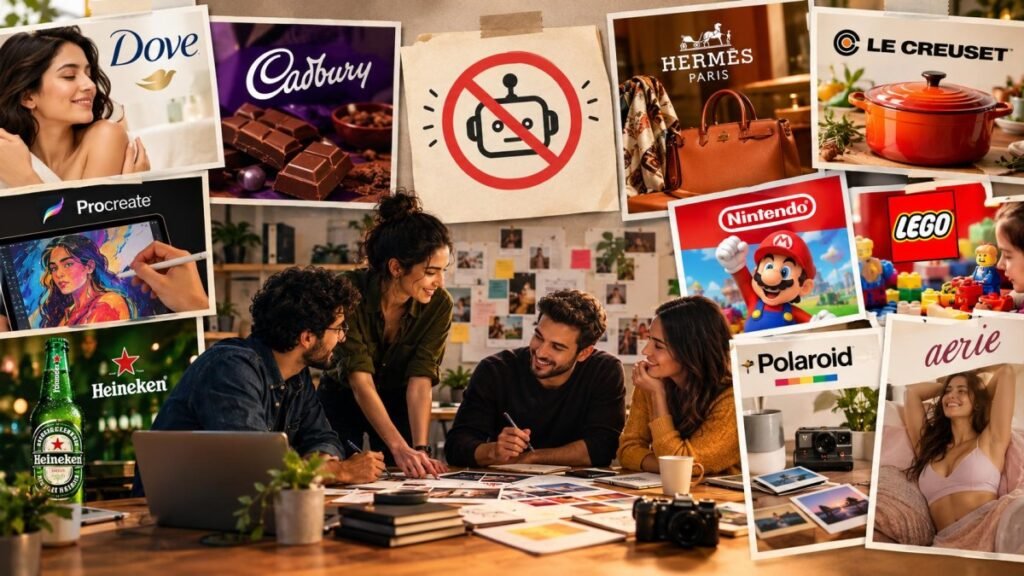
Dove – Real People Over Perfect Prompts
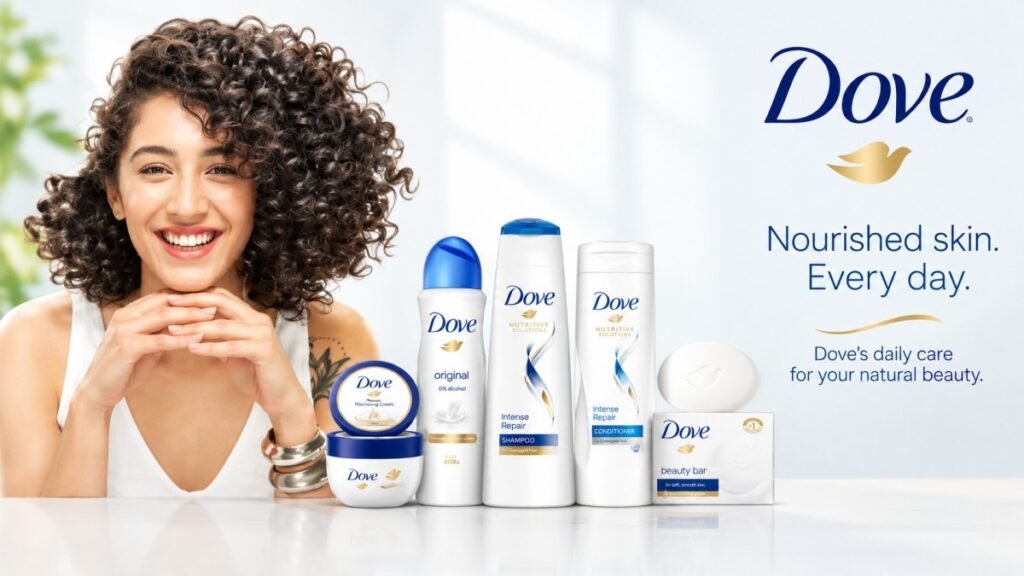
Dove has made authenticity part of its DNA for 20 years. Its 2024 “The Code” campaign took that philosophy into the AI era, showing how image generators can reproduce narrow and unrealistic ideas of beauty.
The brand pledged not to use AI-generated models in place of real women in its advertising. It also created a Real Beauty Prompt Playbook to encourage more representative AI imagery.
That’s smart brand storytelling because Dove isn’t simply saying, “AI is bad.” It’s connecting the technology debate to an issue the brand has already owned for years.
Cadbury – AI Knows Nothing About Love

Cadbury Silk’s “AI Knows Nothing” campaign takes a wonderfully simple route.
The campaign imagines young couples using AI to decide what to say, text, and even how to handle their relationships. Cadbury’s answer? Love isn’t something you generate with a prompt. It’s something you feel.
This gives the brand a lovely human tension: technology can help you communicate, but it cannot manufacture emotion.
Hermès – Let the Artist Hold the Pencil

Hermès has gone in a distinctly handcrafted direction.
While AI-driven campaigns are reshaping the fashion industry, the luxury house recently commissioned artists Sarah Martinon and Armand Béraud for its digital presence, including hand-painted illustrations and animation. Highsnobiety also reports that Hermès worked with more than 50 artists on social content in 2025.
For a house built around craftsmanship, this isn’t a random anti-AI stunt. It fits the product.
That’s the lesson: authentic brand marketing works hardest when the medium reflects what the brand already believes.
Le Creuset – Human Artists, Real Stories

Le Creuset offers another interesting case because its approach isn’t about shouting “no AI” from every billboard.
The brand has continued commissioning artists for its creative work, including Elodie Bouédec for the Château range, Tanu Vasu for Provence, Florence Sweryda for Forêt, and more specifically, their surrealist, quirky campaign to debut their new color, Riviera. Digital artist Ian Padgham created a video showing the brand’s latest ceramic cookware range scaled up to the size of real boats, floating right next to yachts in a Mediterranean harbor.
The contrast is particularly interesting because Le Creuset has also become an accidental character in the AI era. McAfee documented a scam using an AI-cloned Taylor Swift to falsely promote free Le Creuset cookware. The brand quickly clarified that no such promotion existed.
When synthetic content can impersonate brands and celebrities, recognizable human authorship becomes even more valuable.
Procreate – Creativity is Made, Not Generated
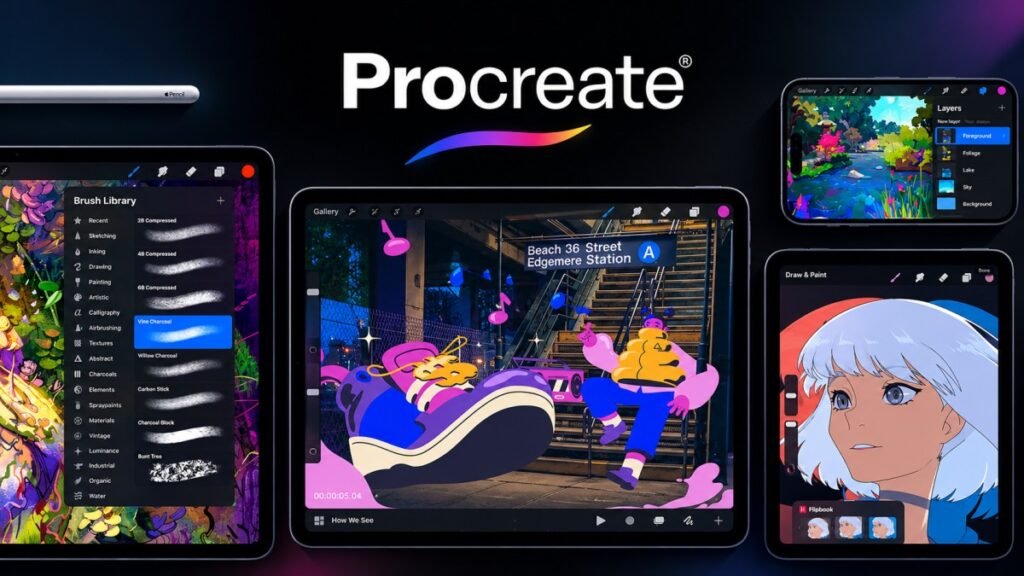
Procreate has taken one of the clearest positions in the creative software space.
The company says, “Creativity is made, not generated,” and has rejected generative AI as the direction for its creative tools. Creative Bloq reports that Procreate’s position received strong support from artists.
This is a fascinating example because Procreate sells tools to creatives. Its product philosophy and its marketing philosophy are essentially having the same conversation: AI vs. human creativity in marketing isn’t just a campaign theme here. It’s part of the brand proposition.
Heineken – Put the Phone Down, Grab a Beer
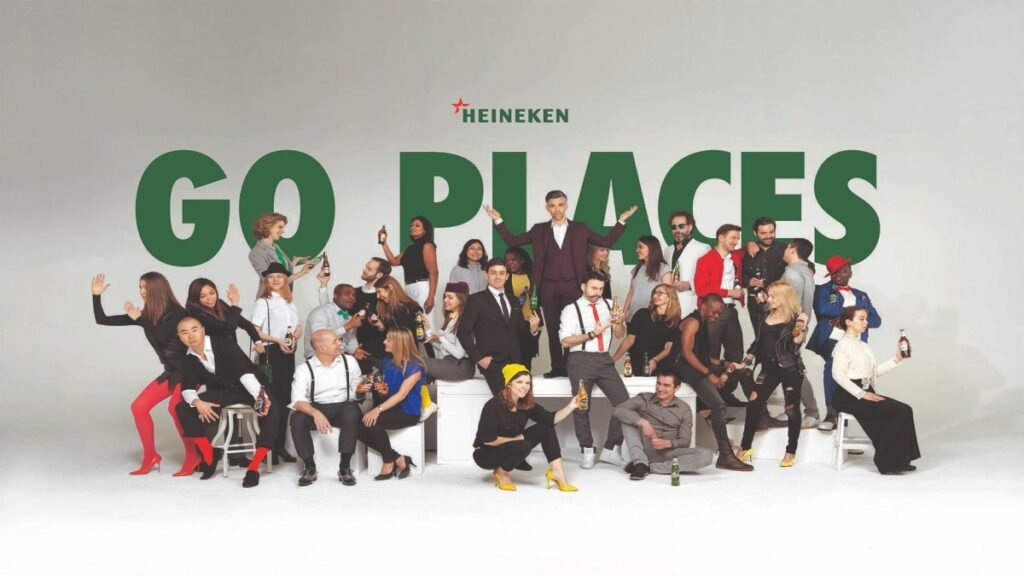
Heineken has found a more playful way into the conversation.
Its “Social Off Socials” work has consistently encouraged people to step away from screens and spend time together in the real world. In 2025, it spoofed AI wearable company Friend by promoting a decidedly analogue “social wearable”: a bottle opener.
It’s cheeky, topical, and most importantly, it makes sense for beer. Good creative marketing campaigns don’t always need the newest technology. Sometimes they need a good joke and a strong understanding of human behavior.
Nintendo – No, Mario Kart Wasn’t AI
Nintendo found itself having to deny something it had not done.
After fans questioned some of the artwork in Mario Kart World, Nintendo stated that AI-generated images weren’t used in the game’s development. The controversy itself showed how quickly audiences now question whether unusual-looking creative work is machine-made.
For Nintendo, the takeaway is less about an advertising campaign and more about trust. When audiences increasingly ask, “Was this made by a human?”, being able to answer clearly matters.
LEGO – Keep the Human Imagination
LEGO is another useful example because it’s not taking an all-or-nothing approach to AI.
In 2026, LEGO CEO Niels B. Christiansen said the company wouldn’t hand the design of its building sets over to AI, while still using AI elsewhere in the business for administrative and standardized tasks. This distinction is important.
LEGO’s core product is about imagination. Keeping humans at the center of that process reinforces the very thing the brand sells.
Polaroid – Make Imperfection the Point
Polaroid may have found one of the neatest answers to the AI conversation. It simply doubled down on being analogue.
Its “The Best of Summer Is Analog” campaign celebrates physical photography, imperfect images, and real-world experiences. The campaign ran across New York, London, and South Korea, alongside phone-free experiences.
The strategy works because Polaroid doesn’t have to invent an anti-AI identity. The product already embodies it. That’s traditional brand marketing with a modern twist—find what makes your product human, then make that the story.
Aerie – Real is the Big Idea
Aerie’s “100% Aerie Real” campaign takes its long-running authenticity platform into the AI age.
The brand pledged not to use AI-generated people or bodies in its marketing. In 2026, Pamela Anderson became the face of a campaign that playfully shows the limitations of prompting artificial models to “feel real.”
The campaign is also a reminder that consistency matters. Aerie’s position against artificial perfection builds on its 2014 #AerieReal commitment to stop retouching people.
What Can You Learn From These Brands?
| Brand | Human-first idea |
| Dove | Real beauty |
| Cadury | Real emotion |
| Hermès | Human craftsmanship |
| Le Creuset | Artist-led storytelling |
| Procreate | Creative authorship |
| Heineken | Real-world connection |
| Nintendo | Creative transparency |
| LEGO | Human imagination |
| Polaroid | Physical experiences |
| Aeries | Real people |
Notice the pattern? None of these brands simply stopped using AI and hoped consumers would applaud. They connected their choice to something bigger.
That’s the real answer to: can you market a brand without AI? Absolutely. But avoiding AI isn’t a strategy on its own.
Your brand still needs a sharp idea, a distinct voice, strong creative direction, and a reason for people to care. The best brand marketing strategies have always started there.
AI can change how marketing gets made. It doesn’t change what makes people remember it.
FAQs
1. Do brands really need AI for marketing?
Not strictly, but it’s fast becoming like having a calculator in math class. You can survive without it, but AI saves enormous time on repetitive tasks—like analyzing data, brainstorming initial ideas, or targeting ads—allowing team members to focus on bigger strategic thinking.
2. Can human creativity beat AI in marketing?
Every single time. AI is great at spotting patterns and predicting what worked in the past, but true creativity is about breaking rules, making unexpected connections, and understanding deep human emotion. AI can draft options, but human intuition and storytelling win people’s hearts.
3. Is AI killing creativity in marketing?
Only if you let it do all the thinking. When used purely as a shortcut to crank out generic content, marketing feels repetitive and dull. But when treated as a tool or sounding board, AI actually frees up time for marketers to think more deeply and spend time on truly creative ideas.
4. Does AI make marketing less authentic?
It certainly can if brands copy-paste generated text without any personal touch. Authenticity comes from real perspectives, genuine human stories, and brand values. If AI is used behind the scenes to do the heavy lifting while humans craft the voice and message, the marketing stays real.


Amilia Brown is a seasoned business writer & strategist who simplifies complex business concepts and turn them into engaging narratives. As a trusted business writer, she delivers actionable insights with precision.




 Indian CEOs in America: A Detailed Account of the Masterminds
 Add Boosters to Your Business Wheels in 2025 with These 5 Strategies
 6 Skills Every Business Leader Should Possess and Hone
 The Vital Role Of Plastic Tubing In Our Medical Infrastructure
 Why Treating Your Employees like Assets and Investing in Them is a Good Idea